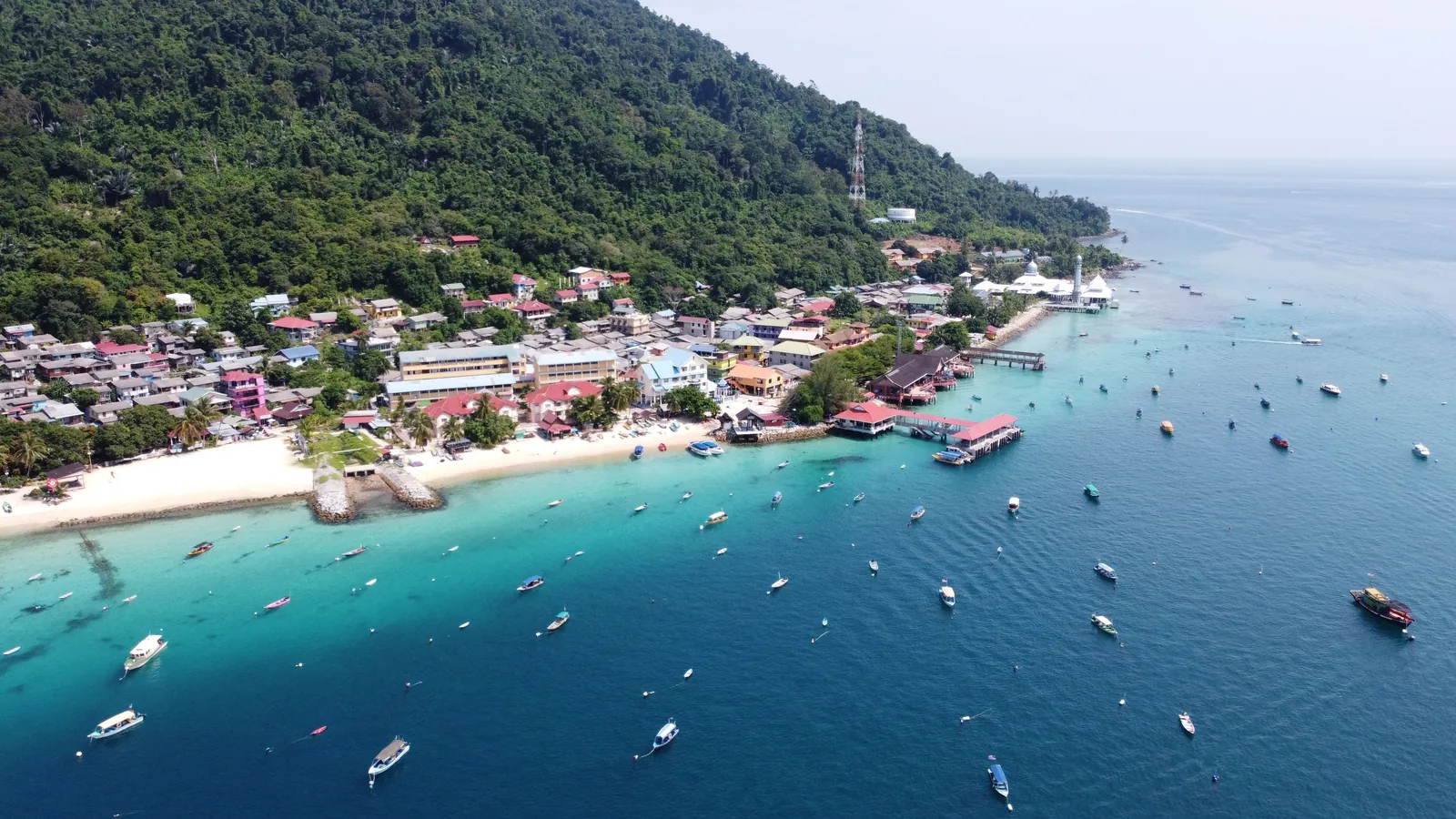
Travelling between November and February? Start by comparing Langkawi before committing to Perhentian, Redang or Tioman. Langkawi is on Peninsular Malaysia’s northwest coast; the other three islands face the South China Sea on the east. Malaysia's northeast monsoon runs broadly from November to March and brings especially heavy rain to that east coast. That distinction can determine whether your carefully chosen island resort is operating at all—not just whether your beach photographs have blue skies.
If your trip is in March through September, the east-coast islands become far more realistic options. But “in season” does not mean guaranteed calm seas, every resort open or swimming safe every day. The right choice comes down to when you can travel, what you want to do and how easily you can absorb a cancelled boat.
Start with your dates, then your holiday
| Your situation | Shortlist first | What you gain | What could spoil the plan |
|---|---|---|---|
| December or January; dates cannot change | Langkawi | A west-coast island with air access and more options that do not depend on a small boat from the east coast | Rain and storms can still affect beaches, excursions or flights. Never promise sunshine |
| March or April; interested in snorkelling | Perhentian or Redang, subject to individual operator reopening | East-coast marine trips start becoming more plausible as the northeast monsoon eases | Early-season resort and boat schedules may not all restart together |
| June to August; want beaches, diving or a quiet island | Perhentian, Redang or Tioman | Closer to the usual east-coast visitor season | Weather, sea conditions and the particular village/resort still matter |
| Late October or November; fixed flight home | Prefer a lower-transfer-risk itinerary; seriously consider Langkawi or mainland options | You can avoid relying entirely on an exposed east-coast sea crossing at the seasonal change | Sudden weather changes and seasonal closures make a tight island-to-flight connection fragile |
These are planning preferences based on typical seasons, not real-time ferry availability or marine safety clearances. Malaysia's Meteorological Department describes the northeast monsoon; its climate explanation places the east coast's heaviest seasonal rainfall generally in November–January. The northwest has a different rainfall rhythm, with January–February usually a relatively drier period. Langkawi is not immune to heavy rain simply because it is west of the peninsula.
What actually changes between the four islands?
Langkawi — the more flexible western option. If you're travelling at Christmas or over the northern winter and still want an island, Langkawi is a logical first search. You can reach it by air, while ferry access from the northwest mainland is another option to check. This offers a way to plan a holiday without depending on an east-coast resort transfer. Its beaches, markets and inland attractions also give you choices when a boat excursion is cancelled. Tourism Malaysia's Langkawi guide identifies November–March as the usual drier season; don't interpret that as a forecast for your specific week. Confirm present-day airport or ferry schedules with the operating carrier.
Perhentian — choose your actual island and lodging, not only its name. Perhentian Kecil and Perhentian Besar are different places, and accommodation choices vary. A traveller who wants a simpler beach stay may shortlist one property; a family seeking a particular room type or calmer beach approach may prefer another. Both usually depend on a boat from Kuala Besut on the Terengganu coast. During the northeast monsoon the risk is not only rain on the beach: a seasonal hotel closure or unsuitable boat conditions can prevent the holiday from starting. Ask your chosen accommodation which mainland departure is used, which operator transfers guests, and what it does if the boat cannot sail. Tourism Malaysia's Terengganu island access guide identifies Kuala Besut as the regular jumping-off point; it does not verify today's sailing.
Redang — a resort-led snorkelling trip requires two confirmed bookings. Redang is attractive for a stay built around a particular resort, boat transfer and snorkelling or diving. That combination makes it an especially poor place to assume your mainland arrival automatically gets you onto the island. Depending on the resort/operator, boats may depart from Merang or Shahbandar near Kuala Terengganu; do not book an arbitrary jetty because one travel website mentions Redang. Tourism Malaysia warns of significant seasonal resort closures around the northeast monsoon. Before paying, get your property's actual opening date, transfer jetty, outbound and return boat service and bad-weather policy in writing. A resort being advertised online is not proof that its transport is operating on your dates.
Tioman — choose the correct village as well as the correct season. Tioman sits farther south, off the Pahang/Johor coast. Visitors commonly travel by boat from Mersing or Tanjung Gemok. Tourism Malaysia describes the island's resort season as becoming active again around March, with more reduced services during the late-October-to-early-February monsoon period. That is a general visitor-season pattern, not a fixed closure law. Crucially, a boat that reaches one Tioman village is not an assurance of a quick road transfer to any other village. Decide which village and beach you need before choosing a crossing, then ask the accommodation about its precise disembarkation point.
A booking that looks cheap can be expensive to unwind
Picture a four-night island holiday with a flight home from Kuala Lumpur immediately after the return boat. You find a cheap room on Redang in early November and a good-looking bus connection back from the coast. The room booking may be real, but you still have three separate dependencies: an open resort, a boat operating at both ends, and enough time to get back to Kuala Lumpur even if the sea crossing is delayed. A good nightly rate cannot fix a missed international flight.
For a late-season east-coast trip, do the expensive parts in this order: ask the resort for its actual operating dates; verify the named boat/jetty and its cancellation or refund arrangement; only then choose mainland transport and onward flights. Where a missed flight would be costly, leave a mainland or city buffer day rather than putting an international departure immediately after the boat. The number of buffer days is a personal risk decision—not a promise that one extra day defeats any storm.
A second traveller wants a five-night January holiday with children and limited flexibility. Rather than chase a Perhentian resort that might not be accepting transfers, they can start with Langkawi and compare accommodation with airport access and activities that do not require a boat. This still does not make a January swim safe: ask a local operator or lifeguard about the exact beach and conditions, and change plans if weather deteriorates.
What does a marine warning actually mean?
The official METMalaysia marine-warning criteria are more useful than an icon showing “showers.” First-category strong-wind/rough-sea alerts describe conditions dangerous for small craft and water sports. Second-category alerts identify danger for ferry operations and other shipping too. Those are official hazard categories, not a calculation that a particular booked boat is safe below an alert threshold.
A sunny morning at your hotel does not prove that the crossing or snorkelling site will be safe in the afternoon. Likewise, a weather forecast for Kota Bharu or Kuala Terengganu alone does not replace a marine forecast for the island route. Check the METMalaysia website or official myCuaca service near departure, then follow the actual ferry operator's decision and any official marine restrictions. Never pressure a crew to sail because you have a hotel reservation. Once on the island, swimming and diving also depend on local currents, visibility, warnings and professional site judgment—not the month on a calendar.
How to build a trip that survives a cancellation
Before transferring non-refundable money, collect four answers from the specific businesses you will use:
- Accommodation: Is it actually open throughout your dates, and is food/transport available nearby?
- Boat: Which precise jetty, operator, departure, arrival village and return crossing serve that property? What happens with rough seas?
- Payments: If the resort operates but the boat is cancelled, who refunds or moves the room and the transfer? Keep both policies in writing; they may be separate contracts.
- Exit plan: Could you spend an extra night on the mainland, rearrange ground transport or switch to Langkawi/mainland sightseeing without losing your international flight?
For Langkawi, replace the east-coast boat dependency with your actual air or west-coast ferry and local excursion conditions; an island flight can still be disrupted. For Perhentian, Redang and Tioman, verify your chosen property's connection rather than a generic “island ferry schedule” search result.
If your trip involves separate flights through Kuala Lumpur International Airport, the KLIA self-transfer guide explains the airport transfer and check-in risks; it cannot protect a connection missed because the island boat was cancelled.
The useful decision is simple: choose the island whose normal operating season fits your dates, then book only after the resort, boat and onward travel work together. If your dates are fixed in the northeast-monsoon peak, moving your shortlist west can be wiser than hoping an east-coast island will behave like it does in July.