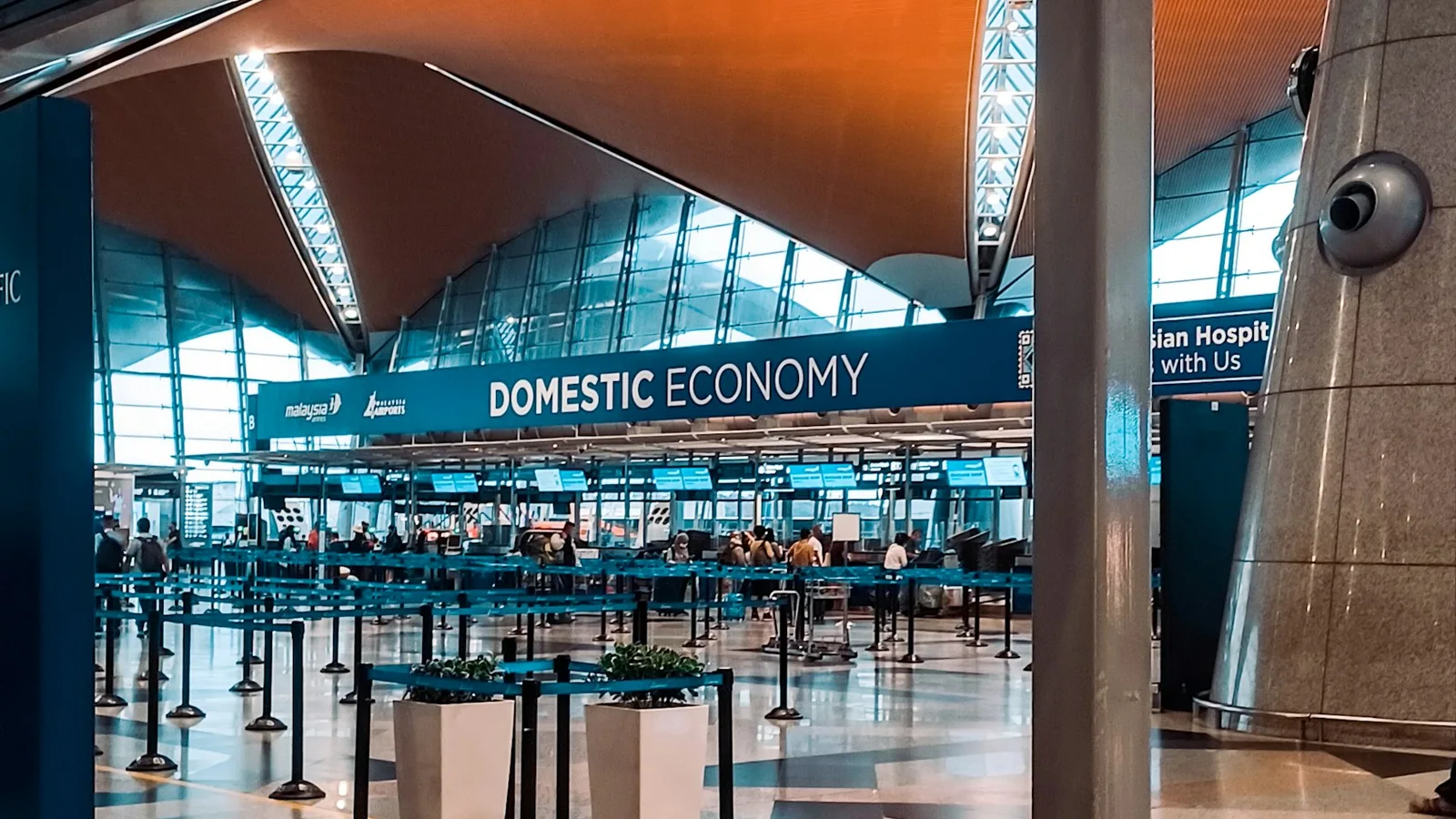
Changing between Kuala Lumpur International Airport (KLIA) Terminal 1 and Terminal 2 on separately booked flights? The KLIA Transit train costs RM2 one way per adult for the terminal-to-terminal trip (3–4 minutes on board); KLIA Ekspres is a separate service with its own timetable and fare. The airport's free shuttle bus runs 24 hours, normally every 15 minutes, with approximately 10 minutes on the bus T1→T2 and 20 minutes T2→T1 because of its car-park loop. Neither figure is a safe total connection time: luggage collection, Malaysian entry clearance where required, the trip to the station or bus stop, and your next airline's check-in deadline can matter much more. (KLIA Transit fares and timetable; Malaysia Airports inter-terminal shuttle)
A separately bought second flight is not automatically protected if the first arrives late. Your real decision is whether you can reach the next airline's earliest check-in, document-check or bag-drop deadline—not merely whether you can physically get between the buildings in 3–4 minutes.
This guide covers separate-ticket self-transfers. It cannot declare one connection duration safe for every passport, bag, airline or departure time.
First, identify what you are buying
Do not decide from the booking website's word “connection” alone. Open the ticket conditions and ask the operating airlines.
| Arrangement | What to establish before purchase |
|---|---|
| An airline-sold through itinerary | Whether baggage is checked through; where immigration happens; what assistance applies after a delay |
| AirAsia Fly-Thru | Whether this particular itinerary is sold as Fly-Thru and what its route-specific transfer instructions require |
| Two separately booked flights | Whether you must collect and recheck bags, obtain a boarding pass landside, and pay for a replacement onward flight after a delay |
| An agency itinerary with a separate transfer guarantee | Who provides that guarantee, what it covers, how to contact them, and what actions could invalidate it |
AirAsia describes Fly-Thru as a connecting product booked under a single reference, with transfer arrangements that depend on the route. Do not assume two individually purchased AirAsia flights receive the same treatment. (AirAsia Fly-Thru service)
A single payment to a travel website is not enough evidence of airline protection. Keep the actual conditions, not just the search-results screenshot.
Then establish whether you need to enter Malaysia
For a connection requiring baggage collection and landside check-in, Malaysia Airports directs passengers through arrival immigration, baggage collection and customs before checking in again. Its guidance also calls for the necessary documents to enter Malaysia. (Malaysia Airports: KLIA flight transfers)
A terminal change must therefore be considered alongside your entry eligibility, not simply the journey between buildings. Check the Malaysian Immigration Department's requirements for your nationality and circumstances, and the official Malaysia Digital Arrival Card information where applicable. (Malaysia Immigration visa requirements) (Malaysia immigration MDAC)
Three questions to resolve before buying:
- Will the first airline tag the bag to the final destination?
- Can the onward airline issue your boarding pass within the transfer area for this exact itinerary?
- Does the proposed route require entering Malaysia, and are you eligible to do so?
Travelling with only cabin baggage may remove the baggage-carousel wait. It does not, by itself, establish that you can stay airside. Obtain itinerary-specific confirmation.
For the wider entry process, use our Malaysia visa and entry guide.
Getting between Terminal 1 and Terminal 2: real fares, stops and schedules
Terminal-to-terminal train — RM2 for an adult, RM1 for a child aged 6–15, one way. The KLIA Transit operator's published fare table covers KLIA T1 to T2, with children under six travelling free under its ticket rules. The rail journey itself is approximately 3–4 minutes depending on direction. KLIA Transit generally runs every 15 minutes in weekday peak hours and 30 minutes off-peak and on weekends. The currently published KLIA Transit timetable lists the first / last departure from T1 towards T2 at 05:39 / 00:39, and from T2 towards T1 at 05:18 / 00:30 (local clock times). These are departures from the indicated terminal, not a guaranteed flight-transfer window; recheck the operator's live schedule and service alerts. These are published train times, not a guaranteed 24-hour service or an airline transfer allowance. KLIA Ekspres has a different published timetable and a late-evening service notice. Check both rail services for your travel time before deciding no train is available: RM2 is the quoted KLIA Transit T1–T2 fare, not a blanket price for every train or ticket. Buy the correct ticket for the service you intend to use. (KLIA Transit operator fares and times; KLIA Ekspres service details)
Where to find the rail service: At Terminal 1, follow signs for the train at Level 1. At Terminal 2, the rail station is at Gateway@klia2. Walking from the aircraft, baggage reclaim or your departure counter to the station takes additional time; do not mistake a 3–4-minute ride for a 3–4-minute airport connection.
Free airport shuttle — 24 hours, generally every 15 minutes. Malaysia Airports lists the Terminal 1 stop at Door 4, Level 1, and the Terminal 2 stop at Bay A10, Level 1 Transportation Hub, Gateway@klia2. Its route runs T1 → T2 → Long Term Car Park → T1. That loop matters: a ride from T2 back to T1 includes the car-park stop. ANA's Kuala Lumpur airport guide estimates about 10 minutes by bus from T1 to T2 and about 20 minutes from T2 to T1 via the car park. These are approximate on-bus times, not guaranteed door-to-door connection times; add up to one bus headway, walking, immigration/baggage and departure checks. The airport operator confirms the loop and frequency but does not guarantee a universal transfer duration. The bus is a more relevant option when the train is not running, provided you can access the public shuttle area. (Malaysia Airports shuttle stops and route)
Do not confuse the T1–T2 ground transfer with Terminal 1's main-building-to-satellite movement, which may involve the Aerotrain. ANA's airport guide treats these as different journeys.
Transport details checked 2 November 2026 against the airport and rail operators. Reconfirm service notices for the date of travel; a timetable is not a promise of onward airline protection.
Work backwards from the earliest deadline
Collect these details from the onward airline:
- Check-in closing time, even if you already checked in online.
- Bag-drop closing time for your flight.
- Any document-check requirement.
- Boarding-gate closing time.
- Where you must be, and by when, if assistance has been arranged.
Use the earliest relevant deadline to assess the arrival process. If the airline's guidance says to arrive substantially earlier, include that too.
Apply the transport facts to your connection
Example 1 — different terminals and a checked bag: Your first flight is due at Terminal 1 at 12:30; your onward separate-ticket flight departs Terminal 2 at 16:00, with a hypothetical 15:00 bag-drop closure. You have 150 minutes before bag drop, not 210 minutes before departure. The train ride is around 3–4 minutes and RM2 for one adult on KLIA Transit, but immigration, baggage delivery, station access, possible train wait, check-in queue and security still need to fit. No official source establishes that these 150 minutes are safe for your exact flight pair.
Example 2 — a night-time terminal change: You land at Terminal 2 after KLIA Transit's listed last departure (check the separate KLIA Ekspres late service schedule too). The free 24-hour shuttle from Bay A10 still operates according to Malaysia Airports, but its T2→long-term-car-park→T1 route differs from the reverse trip. If you have to collect bags and enter Malaysia, entry permission and airline counter opening times remain the first gates.
Example 3 — cabin bag only, next boarding pass already issued: You may avoid checked-baggage collection, but a separate ticket does not automatically give you an airside transfer path. The airline must confirm where the next boarding pass and security/document checks can be completed for the actual terminal pairing.
For a concrete go/no-go decision, obtain the onward airline's earliest relevant deadline and determine whether all necessary arrival steps can be completed before it. If the answer depends on an unbounded immigration queue or an unconfirmed terminal/entry route, favour an overnight stop or a protected through-ticket rather than treating the short 3–4-minute rail journey as a safety margin.
Compare the cost of failure as well as the airfare
Separate tickets may look attractive until you add a checked bag on each booking, a terminal transfer, food during a long wait and a possible overnight stay.
Create two totals:
Planned cost: both tickets, baggage, ground transfer and any accommodation you already intend to use.
Disruption exposure: the replacement onward fare you could afford, accommodation if needed, and any lost prepaid arrangements at the destination.
Disruption exposure is a scenario, not a prediction or an amount an airline will necessarily reimburse. Check the actual airline, agency and insurance terms rather than assuming one party covers the others.
If the onward flight is the last practical departure of the day, or missing it would disrupt an important event, compare an overnight connection or a through itinerary before choosing the cheapest pair of flights.
What to save on your phone
Keep an offline copy of both bookings, the terminal information, the onward airline's deadlines, relevant entry documentation and the contact details for whoever sold any connection protection.
On arrival, follow signs and ask airport or airline staff if the route differs from the instructions you saved. If you are delayed, contact the onward airline or protection provider promptly; do not assume missing the flight automatically triggers rebooking.
For travel into the city after an overnight stop, see transport and getting around Malaysia.